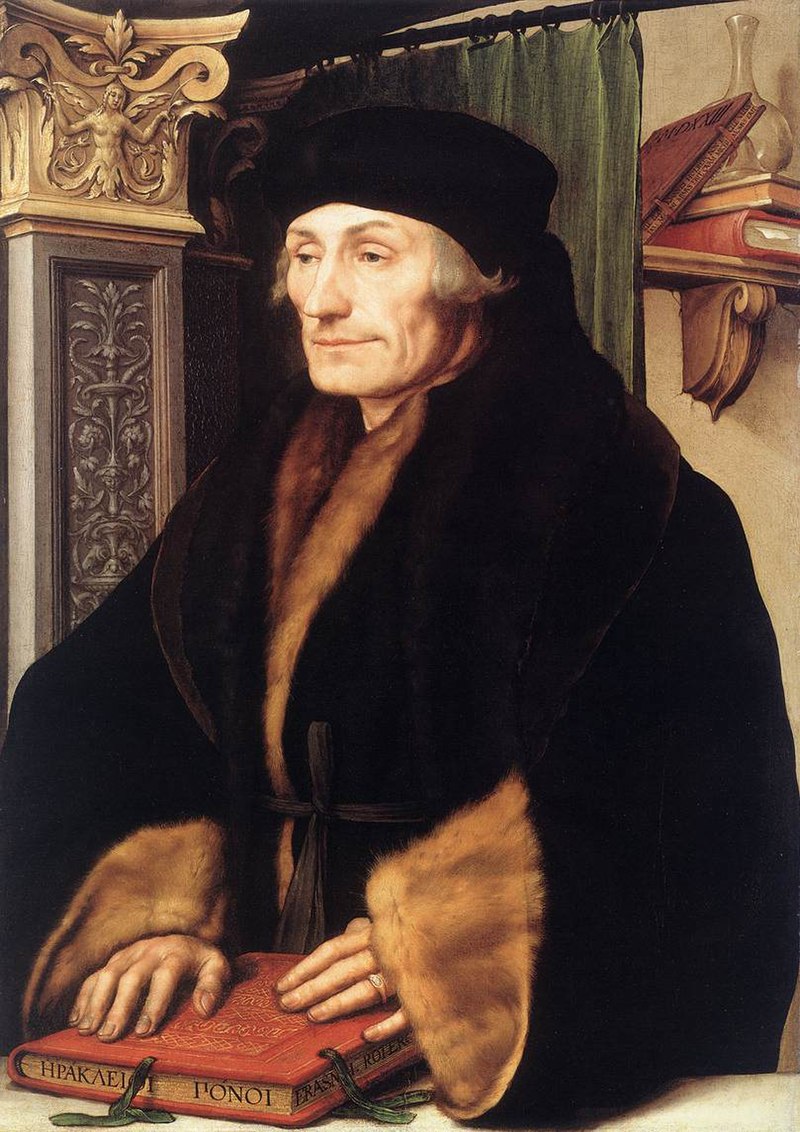
On 2 April 1524, Erasmus wrote a highly confidential letter to one of his closest friends, Conrad Goclenius, professor of Latin at the Collegium Trilingue. To warn his addressee about the top-secret content, he noted above the address a directive in Greek: Ἀναγίνωσκε μόνος καὶ λάθρα. (Allen 1437) “Read alone and in secret.”
After gossiping about several of his opponents, Ulrich von Hutten and Heinrich Eppendorf, Erasmus turned to the appendix of the long letter: his brief autobiography, entitled Compendium, which he claimed to consist of an “Iliad of disasters” (ἰλιάδα κακῶν). This Greek proverb, also featuring in his Adagia (n° 226), added more than a touch of pathos to his self-complaining. Indirectly, Erasmus expressed his hope that others would try to turn his Compendium into a full-fledged biography, a wish he solemnized by adding in Greek: τοῦτο καλῶς ἔσται, a formula difficult to translate but meaning something like “that would be nice.” This wish later materialized thanks to the efforts of Beatus Rhenanus.
After setting out who should receive what from his fortune after his death (the letter serves as a kind of preliminary testament), Erasmus returned to his precarious situation in the present, in Basel. He complained that he was unable to go anywhere, neither to Italy, nor to France, where he sensed that the court had developed sympathies for Luther. He expressed this smouldering Lutheranism with a new Greek verb, ὑπολουθερίζειν, probably to avoid anyone else reading about this accusation. The coining also shows Erasmus’ insight into Greek word formation, combining the prefix ὑπο- (hypo-) ‘under’ but also meaning ‘secretly’ with a Hellenization of Luther’s name and the suffix -ιζω (-izō), meaning ‘to act / think like Luther.’
Erasmus continued by warning his friend Goclenius to be cautious with his letters, as Eppendorf had his minions everywhere and tried to intercept their correspondence, a remark further corroborating the secretive functions Greek played in the Renaissance. Finally, giving an update about his friends, Erasmus mentioned that Karl Harst was living with him instead of his regular servant, because he trusted Harst. Erasmus was, however, worried about his friend’s marital quarrels, again mentioned in Greek. Perhaps Erasmus wanted to avoid that his roommate would find out that he was gossiping about him. Before closing his letter, Erasmus once again warned Goclenius to be careful with his correspondence. The autobiography that followed was, like the letter itself, headed by a secretive Greek title: Ὁ βίος λάθρα, “The biography, in secret.”
Text and discussion are based on Allen (n° 1437). Sandra Langereis also offers good discussion of this letter and the accompanying Compendium.
 Raf Van Rooy